
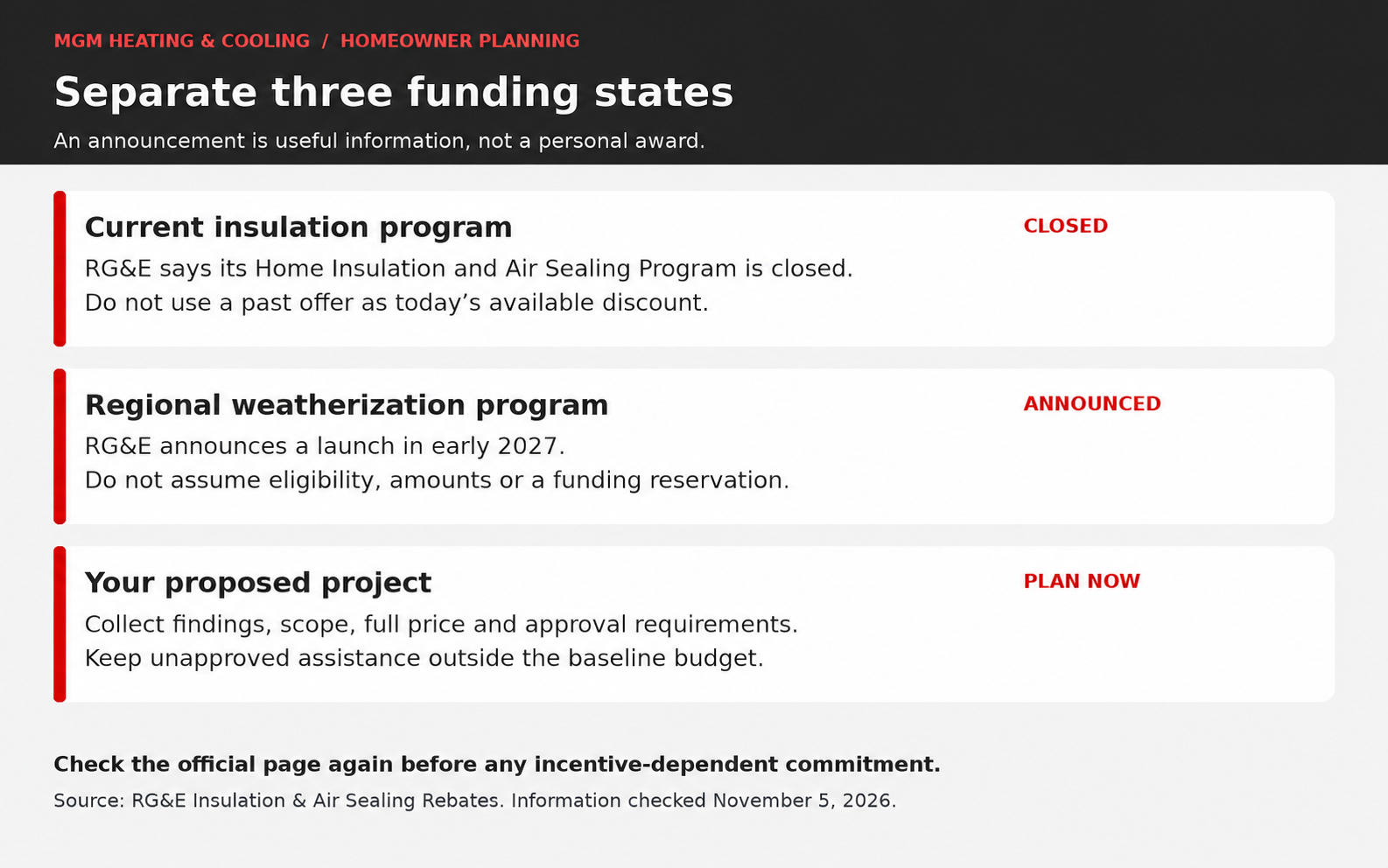
Quick answer: You can document comfort problems, arrange an assessment, compare itemized scopes and build a budget without a rebate. As of November 16, 2026, RG&E says its Home Insulation and Air Sealing Program is closed and announces a regional weatherization program for early 2027. That announcement does not establish your eligibility, a rebate amount or a reserved award. Current RG&E program notice.
Check the current program terms before making a purchase or signing an incentive-dependent agreement.
Write down the problem before selecting the project
A cold upstairs bedroom, a draft near a door and a high winter bill are useful starting observations. They are not a diagnosis or a specification for how much insulation to install.
Make a short comfort log. Note the room, the time of day, the outdoor conditions you noticed and what the heating system was doing. Record whether a problem occurs throughout the home or in one area. Keep recent energy bills, but distinguish energy use from changes in rates or billing periods.
Photograph visible conditions only where you can do so safely. There is no need to enter a confined crawlspace, walk across an unfinished attic or disturb existing materials to prepare for an appointment. Describe inaccessible areas and let the assessor decide how they should be inspected.
This record gives the professional a better question than “Can you add insulation?” It also gives you something to compare against the proposed work.
Ask what an assessment will actually include
Before booking, ask about the assessment's scope, price and deliverables. Will you receive written findings? Which areas are accessible? Does the work include diagnostic testing, or only a visual survey? What additional investigation might be needed?
Ask how moisture, ventilation and combustion equipment will be considered. EPA's weatherization guidance explains why energy improvements need appropriate indoor-air-quality protections. A proposal should not assume that making the home tighter automatically resolves every air-quality concern.
Have the assessor identify any conditions that should be addressed before insulation is added. Ask who would perform that work and whether it is included in the price. A roof leak, for example, raises a different scope question from a missing patch of insulation. You need the actual finding, not a diagnosis based on a photograph in an online article.
Keep any assessment fee separate from assumptions about future reimbursement. If someone says a later program will cover it, request the current written rule supporting that statement.
Request an itemized scope instead of a rebate-led package
A useful proposal describes where work will occur, what materials or methods are proposed, how access will be managed and what verification is included. It should identify exclusions and allowances as well as the total price.
For insulation, ask which areas are included and how existing conditions affect the recommendation. For air sealing, ask which leakage locations the contractor proposes to address. For related work, ask whether ventilation, repairs, removal, disposal and protection of finished areas are included or separately priced.
Avoid choosing between two proposals based only on their total insulation quantity. They may cover different areas or leave different preparation work to the homeowner. Ask each contractor to explain its assumptions in plain language.
Do not use a future rebate target to determine the scope. Start with the assessment and the home's needs, then investigate whether a current program supports the appropriate work.
Build the first budget with no unapproved incentive
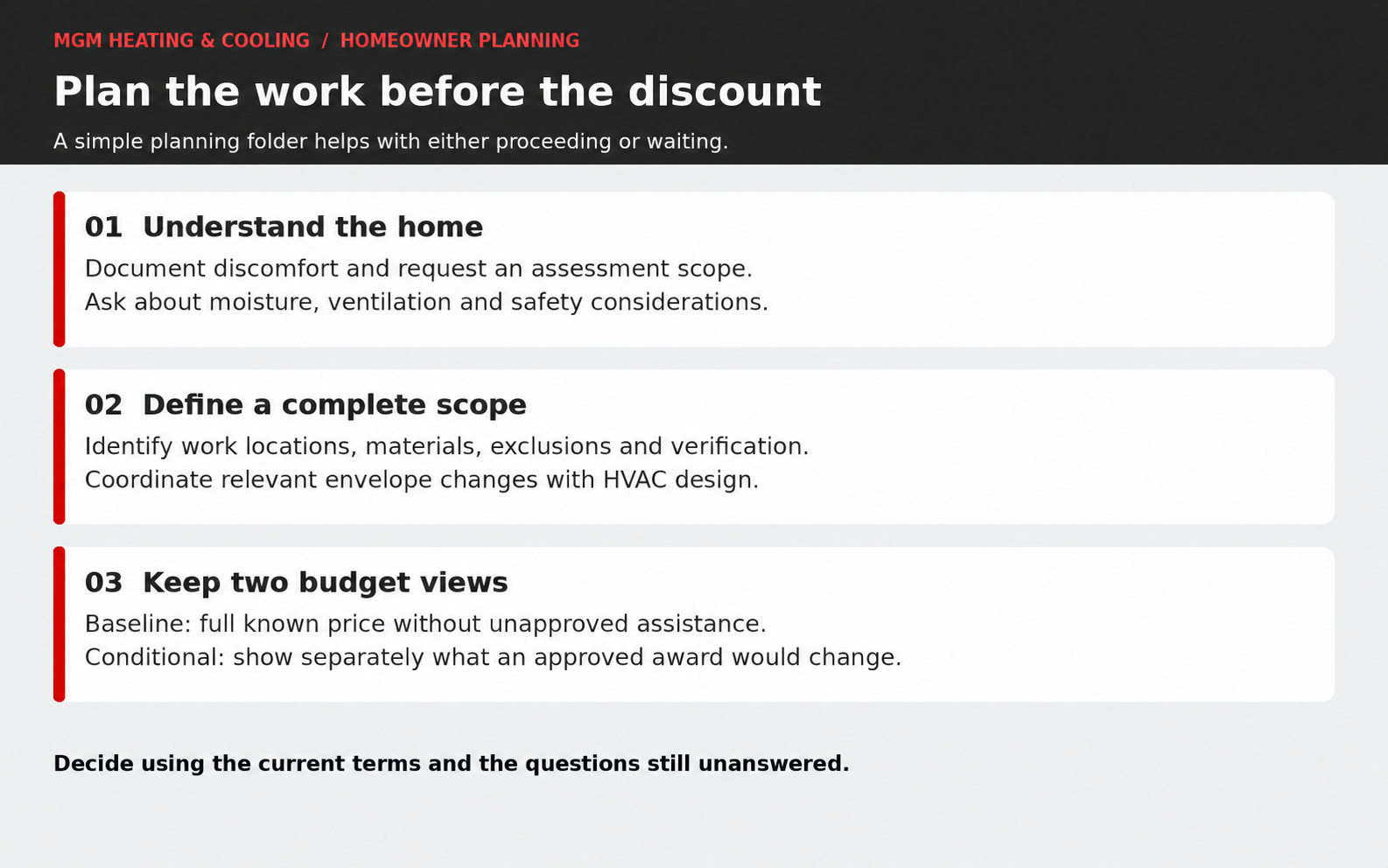
Use the full project price as the baseline. Add identified preparation costs and any separately quoted work. Keep unknown costs visible rather than silently treating them as zero.
Next to that baseline, create a separate column for incentives that are actually confirmed for the project. If none are confirmed, leave the column empty or label it “not approved.” A contractor's estimate, an announced program and a written approval are different records.
Ask what you would owe if funding does not become available. Read payment dates, cancellation terms and any conditions attached to a discount before signing. A proposed schedule should be understandable without a promise about next year's program.
This does not mean every homeowner should proceed immediately or every homeowner should wait. It gives you the information needed to choose. If the price is affordable only with assistance, make that constraint explicit and avoid committing on the assumption that reimbursement will follow.
Coordinate insulation plans with heating plans
Tell an HVAC contractor about planned envelope improvements before finalizing a replacement system. NYSERDA's seal-and-insulate guidance notes that weatherization can affect the heating and cooling equipment a home needs.
Ask which building conditions the equipment design assumes. If the insulation work is still tentative, the proposal should say so. Do not select a smaller system yourself based on a hoped-for future renovation, or assume an existing system's size is automatically correct after substantial changes.
If you need heating work now, describe that urgency separately from the insulation timetable. MGM's heating services information is a starting point for discussing the equipment side of the plan. It does not establish participation in an insulation program or approval for an incentive.
Check other assistance through its own rules
RG&E's closed insulation program does not determine the status of every New York assistance program. NYSERDA's EmPower+ overview describes income-based assistance that can include insulation and air sealing.
Check the current eligibility process directly. Ask about your household, property, proposed measures and required approval sequence. Do not assume that another program reimburses work already completed, uses the same contractors or can be combined with every utility incentive.
Keep sensitive application documents in the official process. A public comment thread is not the place to share income records, full bills or household documentation. A referral to a program is useful; it is not a determination that you qualify.
Keep a compact planning worksheet
Before deciding, collect these six items:
- The comfort problem you want addressed and where it occurs.
- The assessment findings, including unresolved safety or moisture issues.
- An itemized proposed scope with exclusions and verification steps.
- The full price and payment schedule without unapproved assistance.
- The status of each possible program, with a source and date checked.
- A decision point: proceed on the current terms, revise the scope or wait for information that could change affordability.
When the announced program's details become available, compare them with this folder. Check eligible work, timing, contractors, documentation and approval requirements before committing. Do not assume a contact form or expression of interest reserves funding.
The current closure changes the financial planning. It does not prevent you from learning what the home needs. A sound assessment and a clear scope remain useful whether you proceed without assistance, qualify through another route or decide to wait.
About the Author: Gedeon Shikhman